Surfing Guide
Help finding the right surfboard and valuable tips.
Looking for a new board, or maybe just interested in learning more about surfing? Here at Surfers, we’ve been in the surfing business for over 30 years and spend as much time as possible on the water. Our large surf department offers a complete selection from some of the leading brands. The right equipment is the key to a fun experience and quick learning.
We know what it takes to surf in Sweden and around the world. Below, you’ll find guidance and valuable tips that will hopefully help you make the right choice.
/Surfers in Varberg
Guidance & Tips
Choosing the Right Surfboard
The Right Board—So Important for Having Fun
Okay—everyone who surfs knows it’s the most amazing thing there is. Just as well, everyone who surfs knows how difficult it is. Few sports rely as much on the right equipment as surfing does when you’re learning—with the right equipment, it’s easier and faster.
The first thing you need to do is ask yourself: “How good am I—what’s my skill level?” Generally speaking, there are three stages in surfing.
Beginner
A pretty self-explanatory level—you’re new to the board. Maybe you’ve taken a surf class and surfed a little, but you need to practice your paddling technique, pop-up, and finding the right stance on the board. Even if you occasionally manage to catch “a green wave,” you’re still a beginner. In our experience, Swedish surfers tend to stay at this level for quite a while—it takes countless hours of practice to move on.
As a beginner, you need the extra stability provided by softboards, beginner boards, and select longboards and funboards. The right board can be absolutely crucial to whether or not you’ll get up on the board during a session.
Intermediate Surfer
As an intermediate surfer, you’re comfortable on the board and catch the waves you want. You paddle, drop in, find your stance and path on the wave, and make a few turns on the face. Your goal is to surf faster, get closer to the critical point, and add more power to your maneuvers.
Advanced surfer
As an advanced surfer, you surf a lot and fairly consistently. You have the technique and can adapt to the wave and conditions. You’re confident on the wave and are happy to take the chance to “tube.”
Shortboards
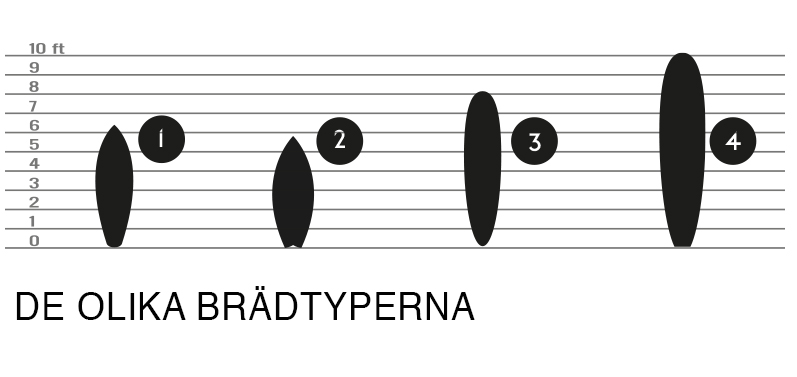
As the name suggests—short, small boards. In this category, you’ll find boards for skilled surfers who want maximum maneuverability. These boards have low volume and require steep, powerful waves—and, above all, an experienced, skilled surfer who knows where to position themselves, both on the wave and at takeoff.
See our shortboardsHybrid
Developments in surfing have progressed rapidly in recent years, and it’s largely thanks to these advancements that surfing has now gained a foothold even in countries where the waves were previously considered too poor. We’ve chosen to call this new generation of shortboards “hybrids.” These are shortboards with increased volume and width, which make it possible to surf progressively on a small board even in Swedish waves. Volume and width, combined with a straighter outline and rocker, give the boards speed and performance.
A hybrid is the right board for the intermediate or advanced surfer who wants to ride a shortboard even in slow waves. But the board doesn’t just deliver in small, slow waves—most models perform well even in head-high waves. Several of the boards are available in a wide range of lengths and volumes, and of course, there’s a big difference between the largest and the smallest.
See our hybrid boardsMini Mals / Funboards
Mini mals are smaller versions of longboards. They have generous volume and a long waterline, which provides speed when paddling and makes it easy to catch the wave. The rounded nose offers stability and control. A mini mal is between 7 and 8 ft.
Funboards are quite similar to mini mals, with the difference being that the nose is slightly smaller. This makes funboards a bit easier to navigate through the waves than a mini mal—but we wouldn’t go so far as to say you can “duck dive” with either mini mals or funboards.
Funboards and mini-mals work well across a wide range of conditions and are the ultimate boards for those who are starting to get the hang of surfing and are looking for a bit more challenge and performance on the wave.
Check out our funboardsLongboards
Master of style! The longboard is the board for days with small waves, or for those who enjoy long rides with plenty of flow and smooth turns.
Longboarding is the most traditional style of surfing. These boards are usually around 9 ft or longer, so they’re substantial boards. The length provides a long waterline, and combined with the volume, this makes them easy to paddle and catch waves with. Some (not all) longboards are therefore a good option for less experienced surfers who want to catch lots of waves.
Longboards are by no means just for beginners—longboard surfing is a religion in its own right, with its own distinct style. With a longboard, you can cruise through the waves, and with the right board (and skill), you can walk up the board and do a hang ten (ten toes over the nose of the board). Longboards with more volume in the nose are often called noseriders. Then there are other longboard models that turn more like a shortboard and offer a more carving-like feel.
Longboards are a board style everyone should have in their quiver—with a longboard, you’ll catch more waves. Longboarding is all about style, so think about what suits you: do you want to turn or glide? Make your choice based on that.
See our longboardsBeginner Boards / Softboards
To make it as easy as possible to catch your first waves and learn how to get up on the board, these boards are large, wide, and thick. The nose is large and round, which makes it easier to paddle and provides better stability.
People often talk about “foam surfing,” which means catching a wave that’s already broken and then surfing straight ahead on the whitewater. With these boards, you’ll get plenty of waves and opportunities to practice your pop-up and stance.
A softboard or beginner’s board should be used in smaller, slower waves (which we have plenty of in Sweden).
Our recommendation is to surf on large boards for a long time, because when you switch to a smaller board, you’ll catch fewer waves. It’s by catching waves that you learn to surf.
Check out our boards for beginnersDifferent Types of Surfboards
Choosing the Right Board
Board facts
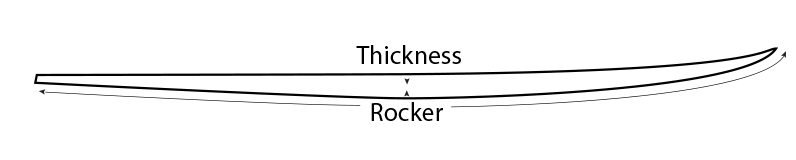
Look at the board’s side profile and you’ll see what’s called the rocker curve—the curve of the board’s nose and tail when viewed from the side. A board with a very pronounced rocker curve is highly maneuverable and turns easily. A flatter rocker makes the board fast but slightly harder to turn. Also look at the board’s outline, or contour line. A wide outline is good for smaller waves, while a narrow outline is better suited for larger, more powerful waves.
Rocker
Rocker refers to how much the board curves from the nose to the tail, and it determines the board’s turning characteristics. The more curvature, the easier the board turns—but that also means less “drive,” which helps you accelerate and maintain speed. In short: if you’re surfing in the wave’s pocket, or on a wave that breaks quickly where fast turns are required, a board with more rocker is preferable. If the wave is fat and slow, a flatter rocker may be better for maintaining speed through the wave’s dead sections.
Thickness
A board that’s slightly thicker floats more easily and is easy to paddle, but it can feel slow and difficult to maneuver for someone who’s small and light. Take your weight and the conditions into account when choosing a board.
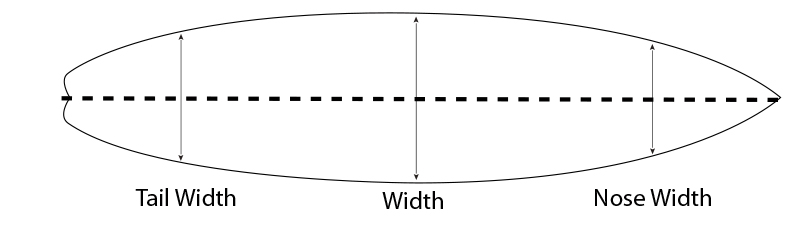
Board width
A wider board is more stable and also planes a little earlier. The width of the tail determines how much grip the board has. Shortboards generally have a wider tail, while guns have a narrower tail for increased drive and stiffness.
Bottom shape
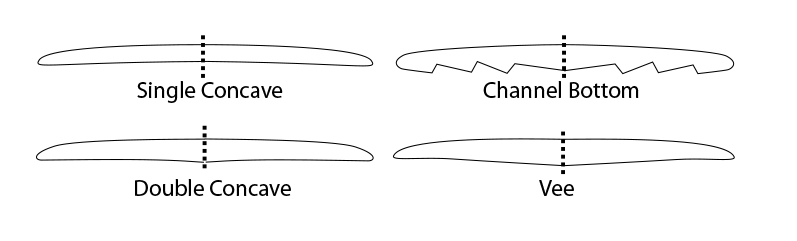
The bottom shape is the curve from rail to rail and is perhaps the most complex and most debated element of your board.
- Concave: causes water to flow under the board toward the tail, providing more acceleration and speed. There are different variations: single concave, double concave, and single-to-double concave (single under the front foot and double under the back foot).
- Channels: are primarily designed to give the board high speed and are perfect for very sharp turns. The downside is that the board can become too grippy and “run on rails” if the channels are too deep.
- V-shape: gives the board the ability to quickly switch from an edge on one rail to the other. The V-shape provides high maneuverability but sacrifices a bit of speed.
The Tail (Rear End)
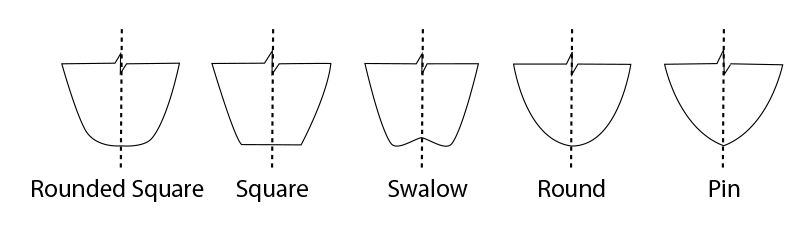
- Rounded square tail: the most popular design for shortboards. Smooth and forgiving in all conditions.
- Square tail: not very common; used for smaller waves. Unfortunately, it’s not as forgiving as the rounded square.
- Swallow tail: provides good drive thanks to a slightly longer rail, but is also a bit looser due to the smaller surface area at the tail. The perfect tail for a fish.
- Round tail: great when edging the rail and provides smoother turns. Suits surfers who are more front-footed.
- Pin tail: the traditional tail for big waves. Holds its grip and rides smoothly—great for holding your line in a wild trough.
Rails
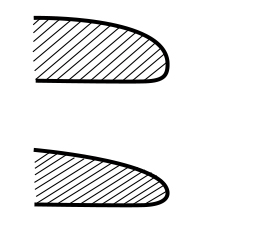
- Boxy/solid rails: more forgiving and suited for shorter, quick turns. Great for surfing in small waves, and they also give the board more volume.
- Low rails: very responsive and tend to dig in and grip the wave. Great for larger, “hollow” or steep waves and for longer, smoother turns.
Fins and Fin Systems
Fin systems
There are several different types of fin systems on the market. The system itself doesn’t make a dramatic difference to the board’s performance—but the fins you put in the boxes can make a huge difference.
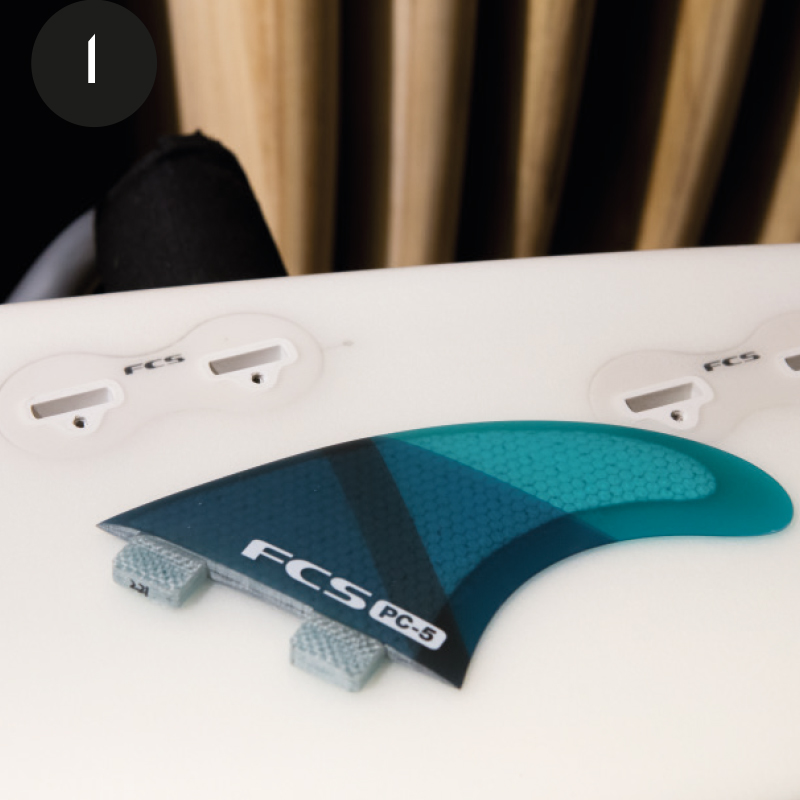
1 – FCS
The most common system of all time. The fin is secured with two screws from the side, and you need a special fin wrench. There are plenty of fins available worldwide for this system.
Buy FCS I Fins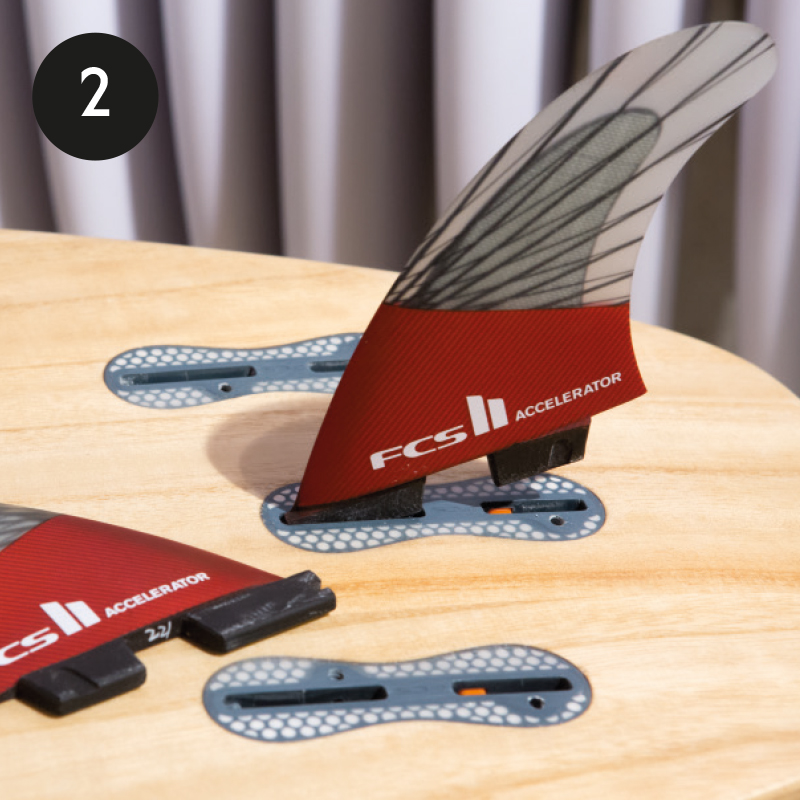
2 – FCS II
An upgrade to the traditional FCS system. With FCS II, no screws are needed—the fins snap into place. The base of FCS II fins is slightly larger than that of standard FCS fins, which allows for more experimentation with the fin’s flex points and thus improves performance. With a “converter set,” you can use old FCS fins in an FCS II box, but FCS II fins cannot be used in an FCS box.
Buy FCS II fins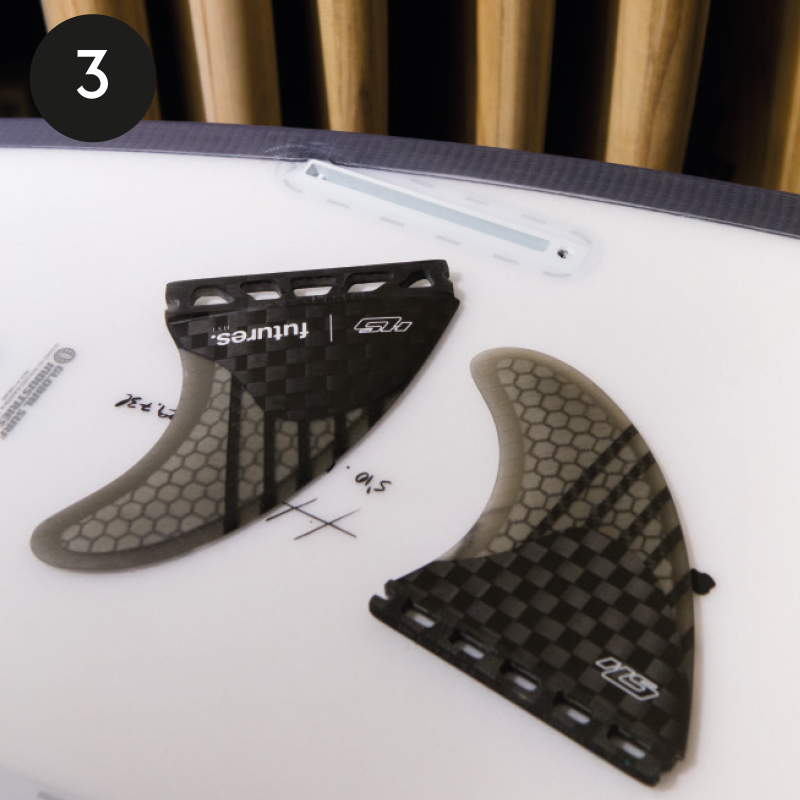
3 – Futures
A fin system that has grown in popularity in recent years. Futures fins are attached to the board with a screw at the leading edge. A Futures fin has a solid base that extends into the box, making it very strong and providing flex at the top of the fin.
Buy Futures fins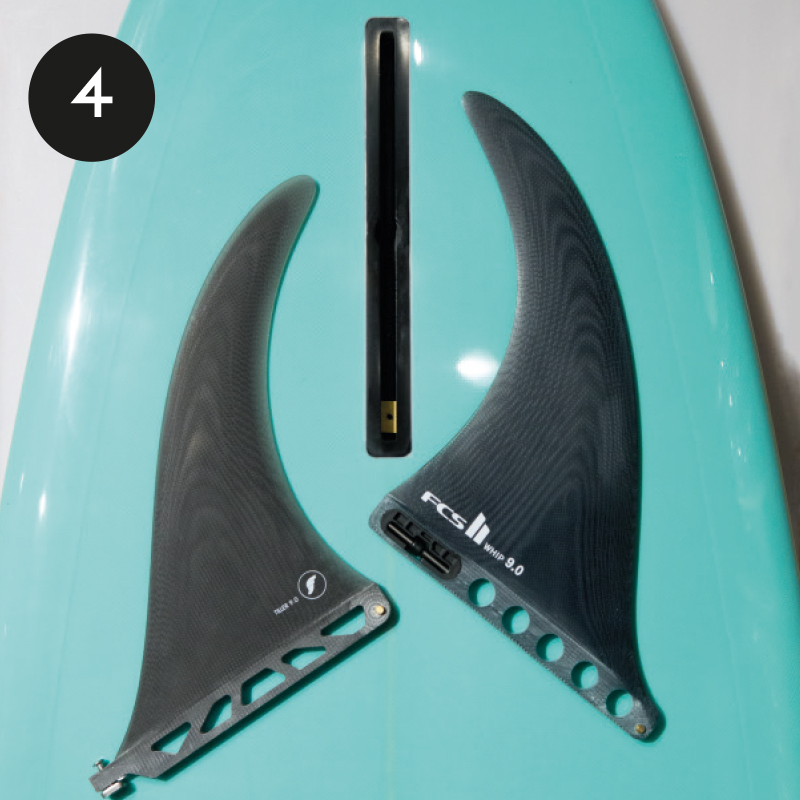
4 – US Box
By far the most common fin system for longboards and single fins. The fin is secured with a screw into a nut that sits in a rail inside the fin box, allowing you to adjust the fin’s position. NOTE: FCS II also fits in US boxes.
Buy longboard finsDifferent Fin Setups
Most boards have removable fins that you can swap out. The material and shape of the fins can make a huge difference in the board’s performance. Surfboards come with different fin setups, and today it’s not uncommon for boards to have five boxes, allowing them to be ridden as a thruster, quad, twin, or single.
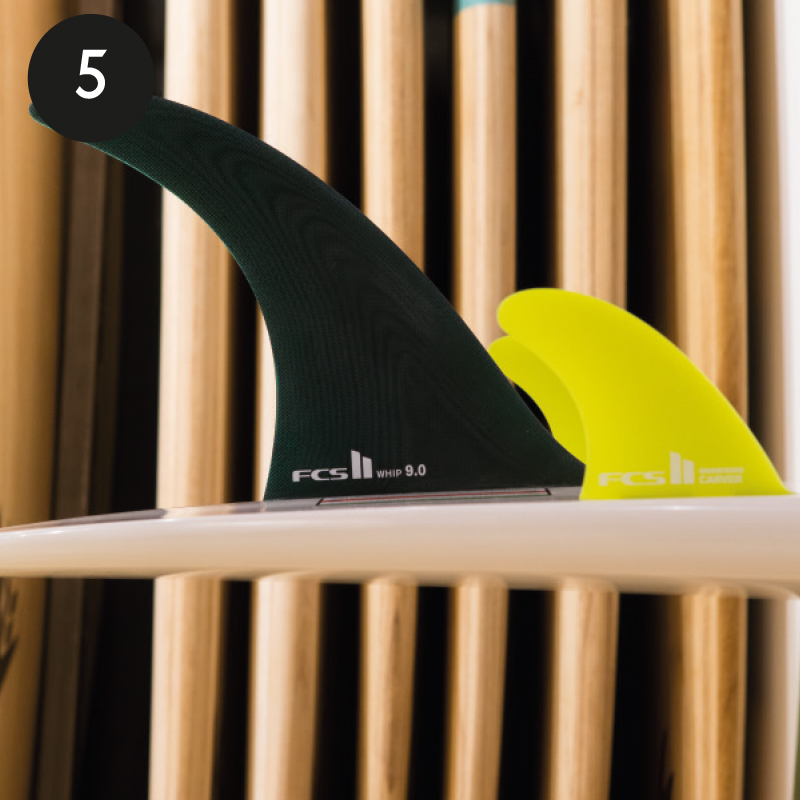
5 – Single or 2+1
Single: With one fin at the back, you need to turn more using the board’s edge. Common on longboards.
2+1: one large single fin at the back and two small side fins.
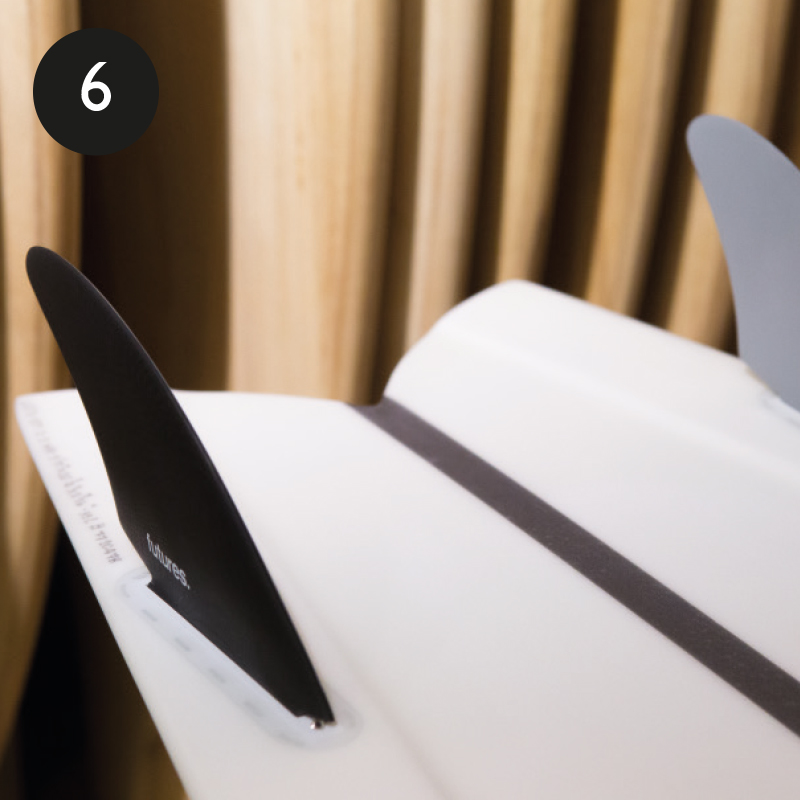
6 – Twin
Two fins provide a bit of drag in the water. Without a center fin to slow them down, twin boards become very fast and gain extra release at the tail. Twin fin setups are sometimes found on boards with a fishtail.
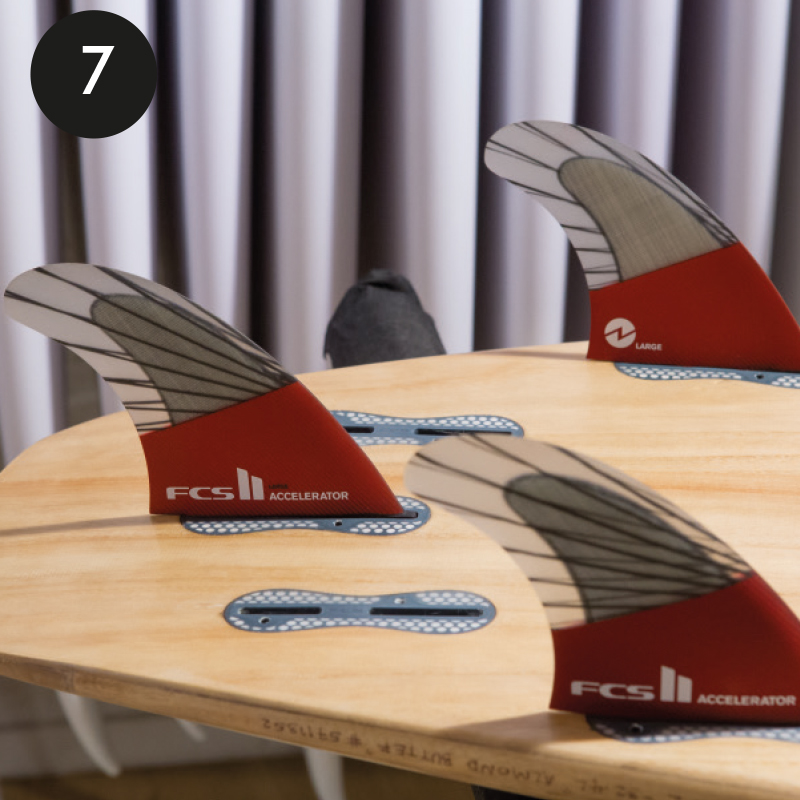
7 – Thruster
The most common setup. Three fins provide drive and stability and work well for most people, regardless of conditions.
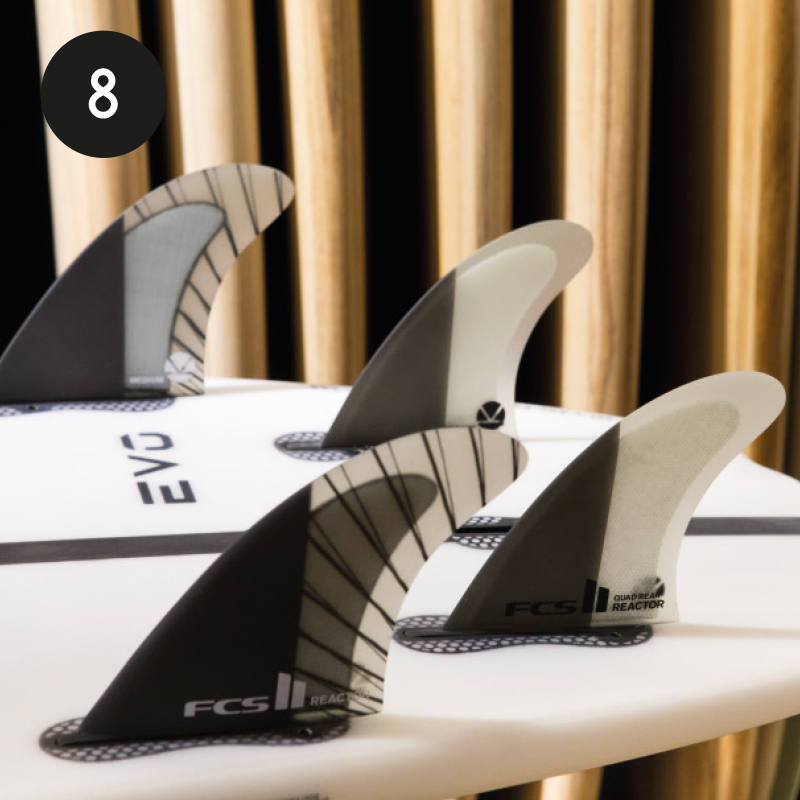
8 – Quad
Four fins provide drive and control with good release during turns. A quad setup is great when you’re going really fast.
Wax, pads, and leash
Wax
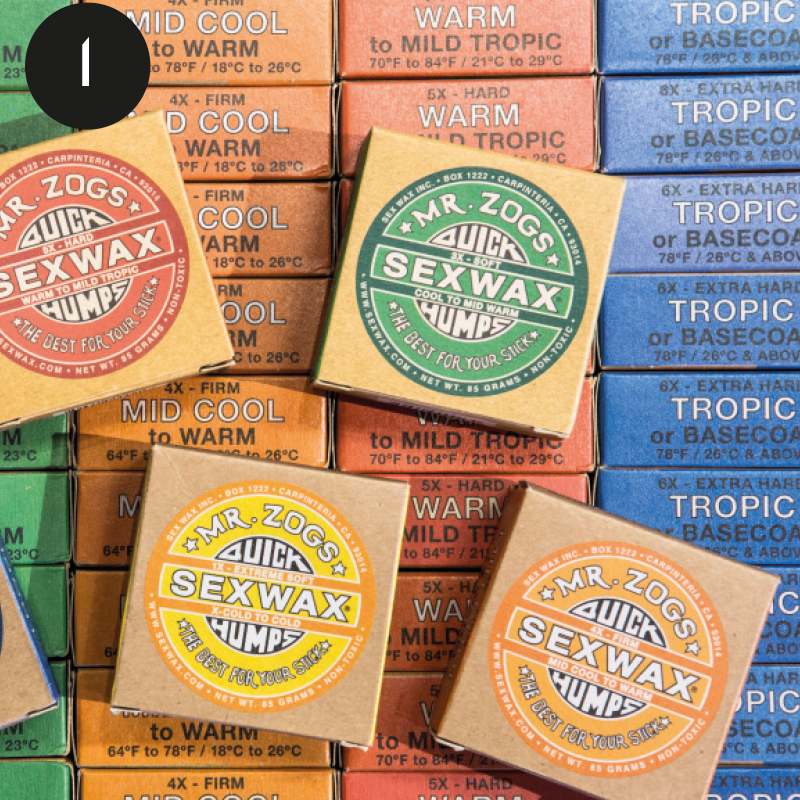
1 – Why wax?
To prevent you from slipping on the board, you apply wax to the top of the board. The wax prevents you from sliding off the board while paddling and from slipping when you stand up. The hardness of the wax varies with water and air temperature: in cold water, you need a soft wax, and in warm water, a hard one.
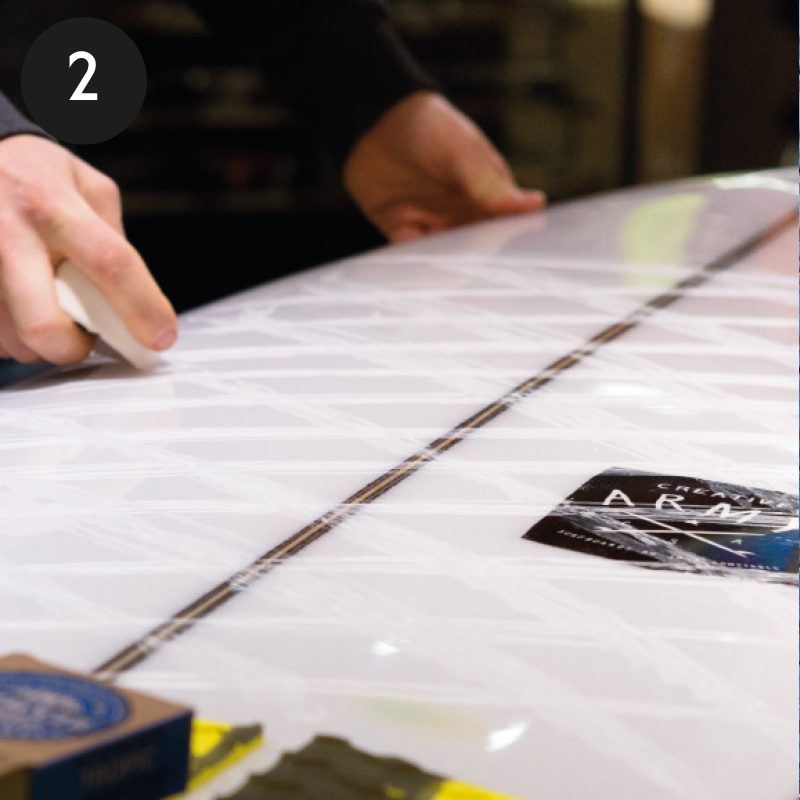
2 – Base Coat
Always apply a hard wax (base coat) to the bottom. The hard wax creates a base that helps the softer wax adhere to the board. Feel free to apply the base coat in a pattern, such as crisscross or straight lines. Then you can smooth out the wax in circles.
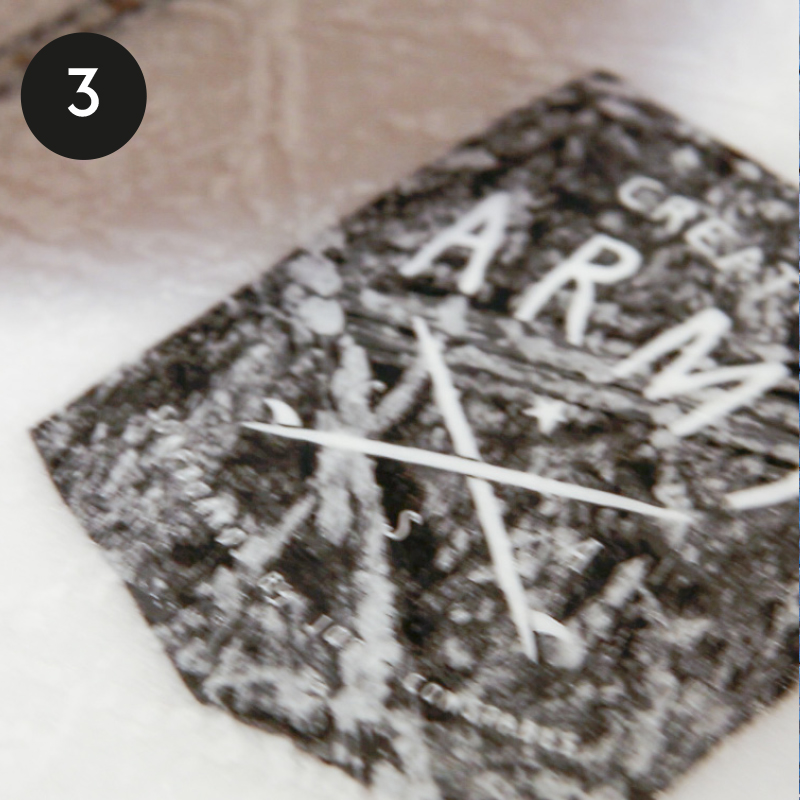
3 – Topcoat
Apply in circles. You don’t need to press as hard here—just spread it until you see it adhere. Re-wax with a topcoat before every session.
Buy waxVideo – How to wax your board
Pads
Pads are mounted on the back of the board to provide grip and feel. They come in lots of different designs, but they all serve the same purpose. The tail pad provides better grip and lets you angle your foot without slipping—which is very important during radical turns. It’s also easier to find the right position with your back foot: with your foot on the tail pad, you know you’re standing correctly, so to speak.
Tail pads are recommended for all boards under 8 ft.
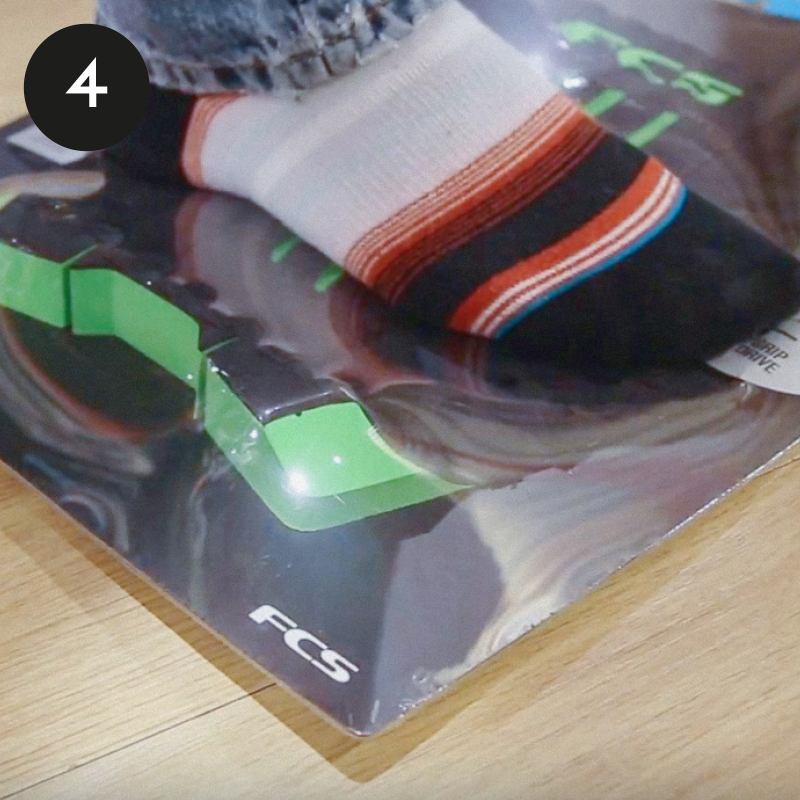
4 – Choose a Pad
There are tons of different pads: two-piece, three-piece, varying widths depending on the shape of your tail, and—last but not least—different shapes depending on how high your arch is. The best thing to do is lay the pads on the floor in the store and test which one feels best.
Check out our pads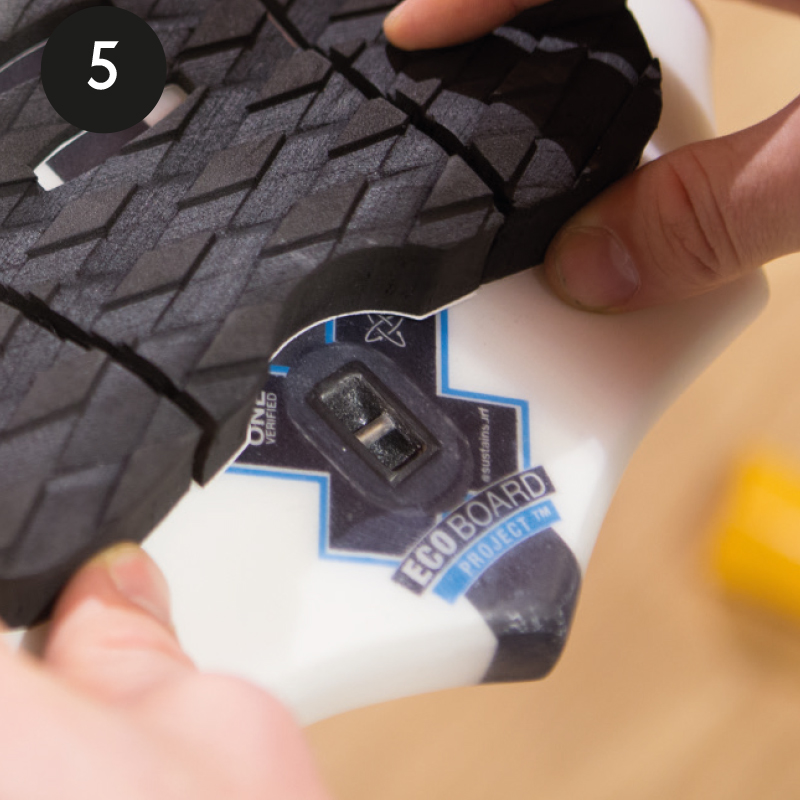
5/6 – Prepare
Start by cleaning the board thoroughly. Test the placement before sticking the pad on. Keep in mind that it should be positioned as far back as possible (under the fins) for maximum effect.
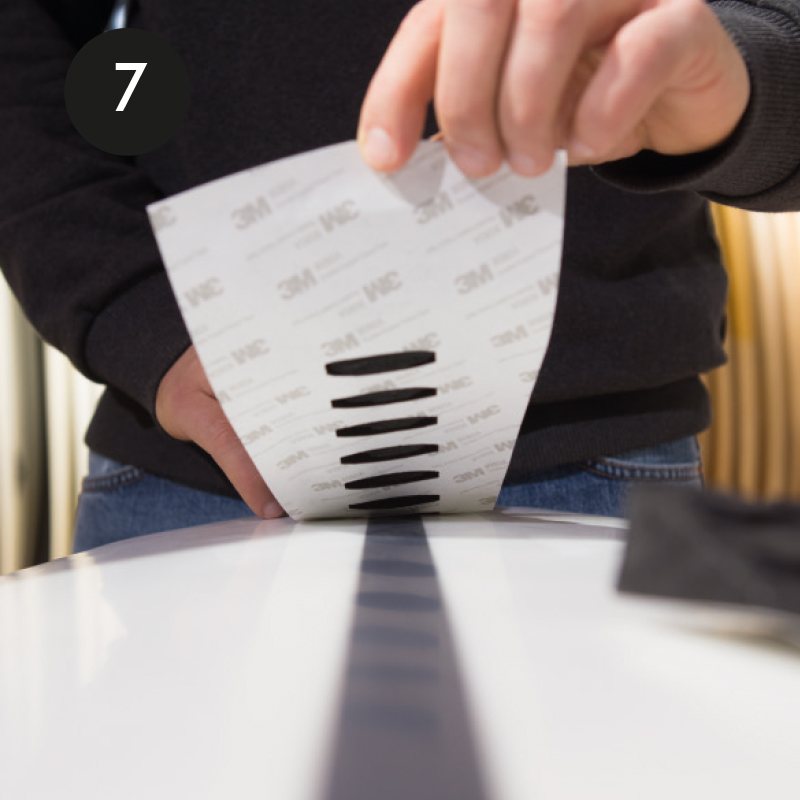
7 – Attach
Now you can stick the pad in place. Always start with the center piece and make sure it’s straight. Then you can attach the side pieces.
Video – How to Attach Pads
Leash
The leash is an elastic safety line between you and the board. It attaches around your ankle with a Velcro strap and to the tail of the board. The leash ensures you stay connected to the board at all times and prevents it from drifting away with the waves when you fall. It’s a safety measure for you, but also for other surfers.
A leash should be about the same length as your board.
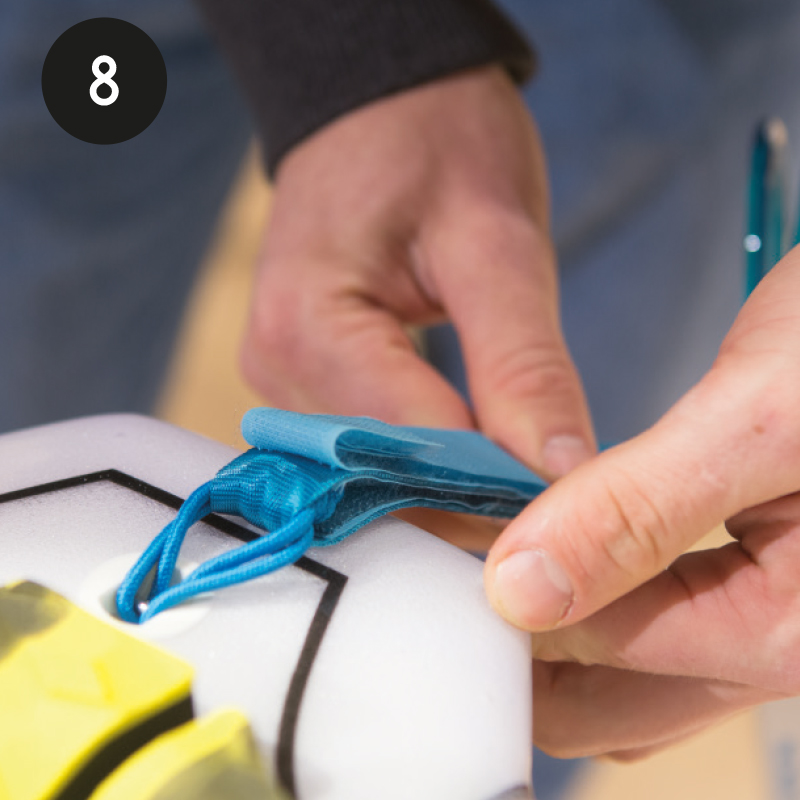
8 – When attaching the leash to the board, keep the end that’s attached to the board as short as possible. If the end is too long, you risk damaging the board’s edge—so make sure the leash’s “rail saver” protects the edge.
Transporting Your Board
Choose the Right Bag
Are you traveling with one or more boards? Or do you just want a simple bag to protect your board at home and in the car? Here are some tips for choosing the right one.

Board sock
A stretchy sleeve that protects against scratches and the sun, but also protects your car from wax. Available in all sizes. A great addition to your travel bag, but definitely not meant for traveling with.
See our board socks
Classic & Day Bag
A slightly lighter padding that’s perfect for everyday use, but definitely not designed for air travel. The padding is usually between 3 and 7 mm.
See our daybags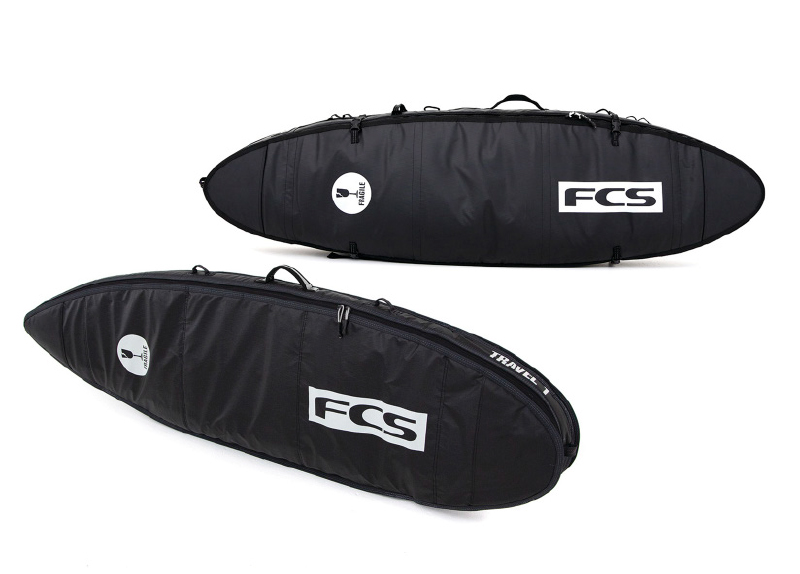
Travel Cover
Approved for air travel! Sturdy construction and excellent padding, with extra-thick protection at the rails, tail, and nose. Available in a wide variety of styles depending on whether you’re carrying one or five boards. The padding is usually between 10 and 15 mm.
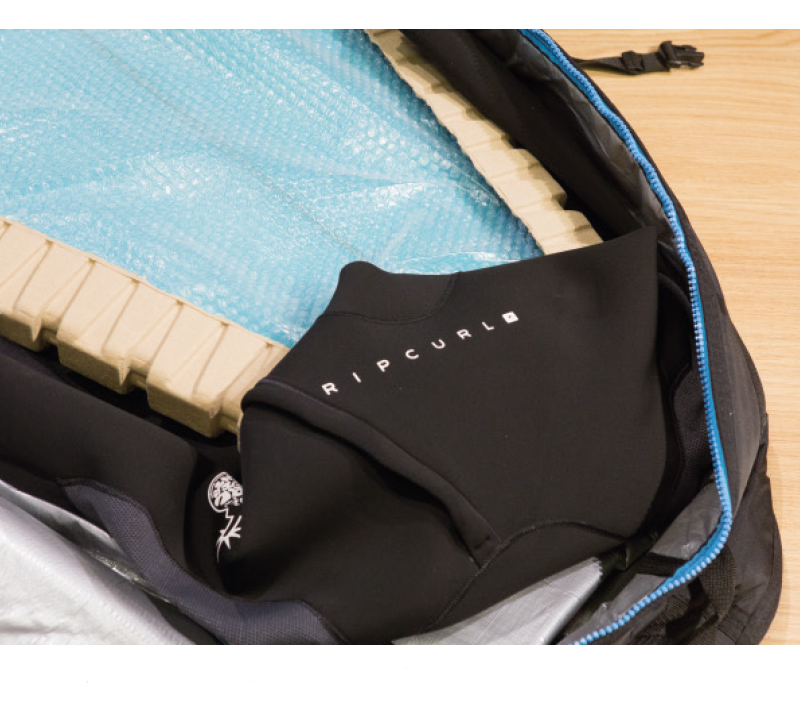
See our travel bagsRemove the fins and old wax from your board—it’s no fun if your cold-water wax melts all over your bag when you land in a warmer country. A board sleeve or bubble wrap is good to have, and feel free to use pipe insulation or cardboard to protect the rails. A wetsuit is also perfect for protecting the nose or tail. Wrap the fins in a towel if you don’t have a fin bag.