
Buy Your First Wingfoil Gear—The Complete Guide
Everything you need to know to choose the right wing, board, and foil.
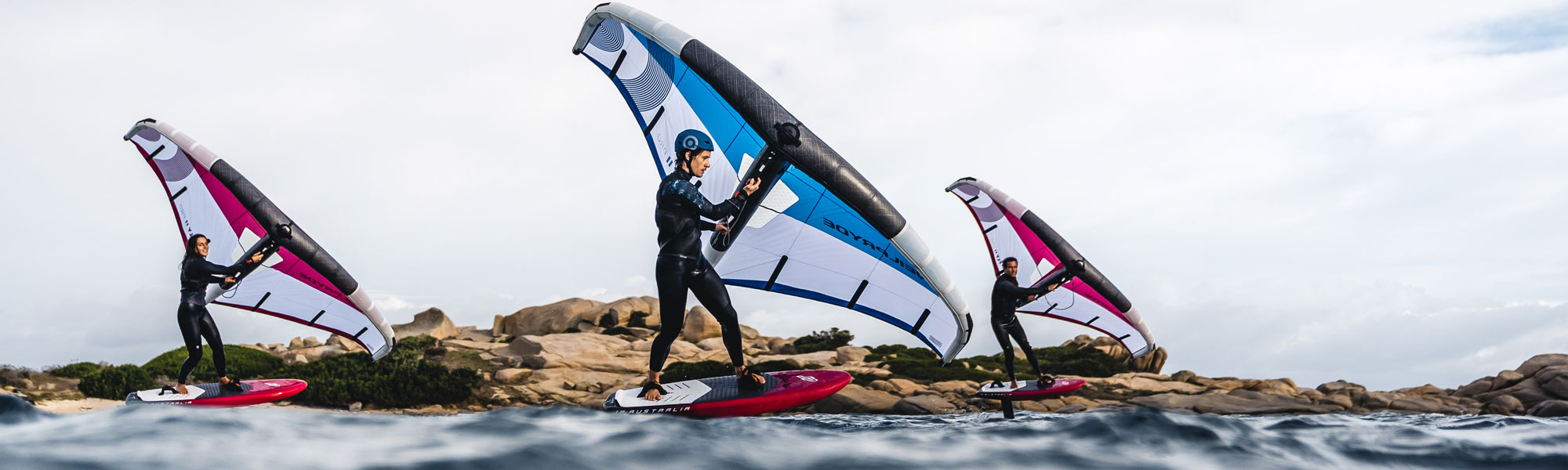
Are you eager to start wingfoiling but unsure which gear to choose? We at Surfers in Varberg will help you get it right from the start.
Wingfoiling is an amazing sport that combines wind, water, and the sensation of gliding almost silently across the water’s surface. But with so many different models, sizes, and designs, it can be hard to know what’s best for you.
In this guide, we’ll walk you through everything you need to know before making your first purchase. We’ll explain the differences between various wings, how to choose the right board and foil, which sizes suit your weight, and what you should keep in mind to improve as quickly as possible.
Contents
Part 1
What do you need to get started with wingfoiling?
A complete set of wingfoil gear consists of three main parts:
The wing—your engine
The wing is the inflatable wing you hold in your hands. It catches the wind and propels you forward. Its size, shape, and construction determine how much power it generates and how easy it is to control.
The board—your platform
The board provides buoyancy and balance. For a beginner, it’s important to choose a board with enough volume and stability to easily stand up and handle the wing.
The foil—what makes you fly
The foil is attached under the board and works much like an airplane wing underwater. When you build up enough speed, it generates lift and the board rises above the water’s surface.
In addition to these three components, you’ll need a pump, a leash for the wing and board, a helmet, a suitable buoyancy or impact vest, and a wetsuit suited to the water temperature.
Buy gear that makes it easy to learn, not the most advanced gear. A stable board and a forgiving foil make a bigger difference in the beginning than low weight and advanced materials.
Choose the Right Wing—Which Type Is Right for You?
There are several different types of wings on the market. The differences mainly concern intended use, construction, stiffness, and how the wing delivers its power.
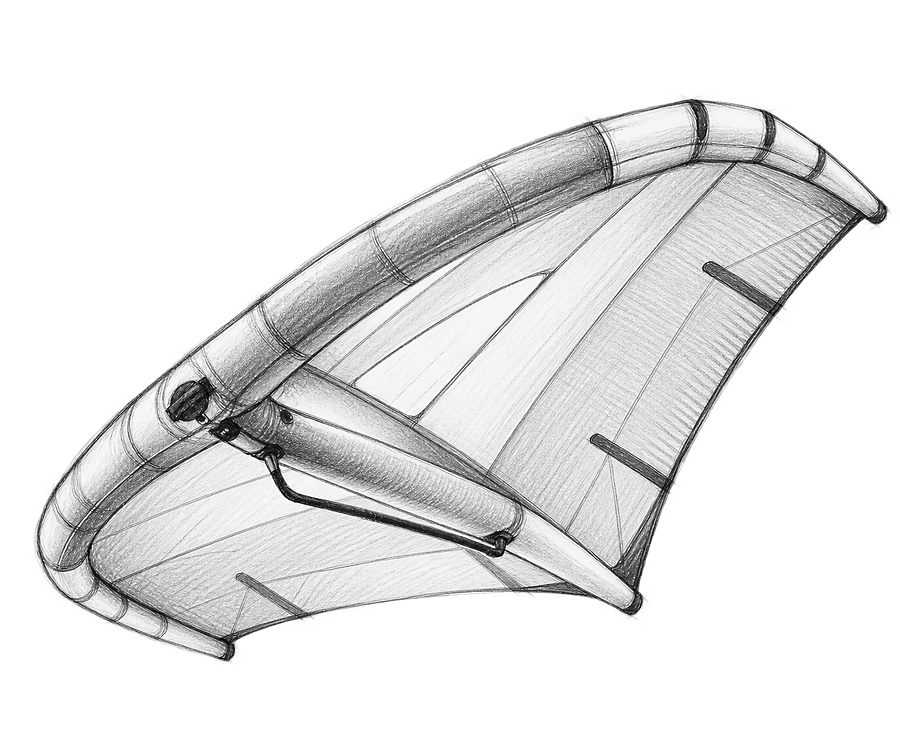
All-Around / Freeride –Recommended
An all-around wing is designed to perform well in a wide range of conditions. It typically provides good power at lower speeds, is stable, and has a wide usable wind range. This is the type of wing we recommend for most beginners.
- Easy to handle and control.
- Good power to get up on the foil.
- Performs well in varying wind conditions.
- Suitable for both beginners and more experienced riders.
- A wing you can continue to use as you progress.
Waves/Surfing
Wings designed for wave riding and for maintaining stability while surfing with less pull from the wing. They’re often lightweight, agile, and have good drifting characteristics.
They can work for beginners, but are especially useful once you’ve learned the basics and want to start surfing waves.
Race / Performance
Performance wings are designed for high speed, efficiency, and maximum control under load. They often use stiffer materials and more advanced designs.
They can be very efficient, but are usually more expensive and not necessarily easier to learn with.
Choose a modern all-around or freeride wing as your first wing. It will give you a good combination of stability, power, and control.
Part 3
Soft handles, hard handles, or a boom?
One of the most obvious differences between different wings is how you hold them.
Soft handles
Traditional soft handles are made of fabric and are attached to the wing’s center strut.
Advantages
- Lightweight.
- Easy to pack.
- Often lower price.
Disadvantages
- Less direct feel—slippery
- Limited grip positions.
- May feel less precise.
Hard handles
Hard handles have become very common on modern wings.
Advantages
- Direct and clear control.
- Good precision.
- Easy to adjust the wing’s angle.
- Stable feel even in stronger winds.
Bomb
A boom runs along most of the wing’s center strut, allowing you to position your hands more freely.
Advantages
- Free hand placement.
- Easy to grip.
- Good control during maneuvers.
- Appreciated by most.
We often recommend hard handles or a boom. They provide a direct and clear feel that makes it easy to control the wing.
Part 4
What’s the difference between a cheap and an expensive wing?
Price differences between wings can be significant. This depends primarily on the materials, construction, and how well the wing retains its shape under load.
Standard Construction
Most wings are made with an inflatable frame made of Dacron or a similar material and a special sail fabric. This provides a good combination of durability, performance, and price.
For most beginners, this is a very good option.
Premium construction
More expensive wings may use materials such as Aluula or other advanced fabrics. These materials can offer:
- Lower weight.
- Greater stiffness.
- More direct response.
- Better shape stability.
- A wider usable wind range.
The difference is often most noticeable when you start riding faster, jumping, or pushing your gear harder.
You don’t need to buy the most expensive wing to get started. A good all-around wing with a standard design goes a long way and often offers great value for the money.
Part 5
What size wing should you choose?
Wing size is measured in square meters (m²). A larger wing generally provides more power in light winds, while a smaller wing is easier to control in strong winds.
The right size depends primarily on:
- Your body weight.
- How strong the wind is.
- Your height.
- Your experience.
- How efficient your foil is.
Size Guide – First Wing
| Body weight | Recommended wing |
|---|---|
| 50–65 kg | 3.5–4.5 m² |
| 65–75 kg | 4.5–5 m² |
| 75–85 kg | 5–5.5 m² |
| 85–100 kg | 5.5–6 m² |
| Over 100 kg | 6–7 m² |
These sizes are approximate guidelines for an all-around wing. Wind conditions and wing model may affect your choice.
How does wind speed affect size?
| Wind speed | Wing size (approx. 80 kg) |
|---|---|
| 5–7 m/s | 6–7 m² |
| 7–9 m/s | 5–6 m² |
| 9–11 m/s | 4–5 m² |
| 11–14 m/s | 3.5–4.5 m² |
Based on a person weighing approximately 80 kg. These are approximate examples, not exact wind ranges. In light winds, better technique is often required to get up on the foil. Strong and gusty winds are unsuitable for beginners.
Do you need multiple kites?
No, not at first. It’s better to buy a wing that performs well in the conditions where you’ll be riding most often. As you improve, you can add another size to expand your wind range.
If you weigh around 80 kg and are planning to start wing foiling in Varberg, an all-around wing of 5–5.5 m² is often a good first choice. If you later want to add two more wings, 4 and 6 m², for example, can be a good combination.
Part 6
Choose the Right Board—Perhaps the Most Important Decision
When buying your first wingfoil gear, choosing the right board is one of the most important decisions.
Many people think they should buy a smaller board right away so they don’t have to switch when they get better. The problem is that this can make learning significantly harder.
A board with enough volume lets you focus on handling the wing and learning to control the foil instead of constantly struggling with your balance.
How much volume do you need?
A board’s volume is measured in liters. A good rule of thumb for an adult beginner is to choose a board with about20–40 liters more volume than your body weight in kilograms.
These are general guidelines. The board’s width, shape, and volume distribution also affect stability.
| Body Weight | Recommended volume |
|---|---|
| 60 kg | 80–100 liters |
| 70 kg | 90–110 liters |
| 80 kg | 100–120 liters |
| 90 kg | 110–130 liters |
| 100 kg | 120–140 liters |
| 110 kg | 130–150 liters |
What does the shape of the board matter?
Width
A wider board usually provides better lateral stability and makes it easier to stand up.
Length
A longer board can provide better glide and make it easier to build up speed before the foil lifts.
Bottom shape
Affects how the board moves through the water, breaks the surface, and behaves during landings.
Volume Distribution
Two boards with the same volume can feel completely different. A wide and stable board can be significantly easier to handle than a long and narrow model.
Traditional wing foil board or midlength?
Traditional wingfoil board
Relatively short and wide. Designed to be stable, compact, and easy to maneuver.
Midlength
Longer and narrower, and has become increasingly common. The main advantage is that it glides more efficiently through the water. This can make it easier to build speed and get up on the foil, especially in lighter winds. However, it isn’t always as stable side-to-side.
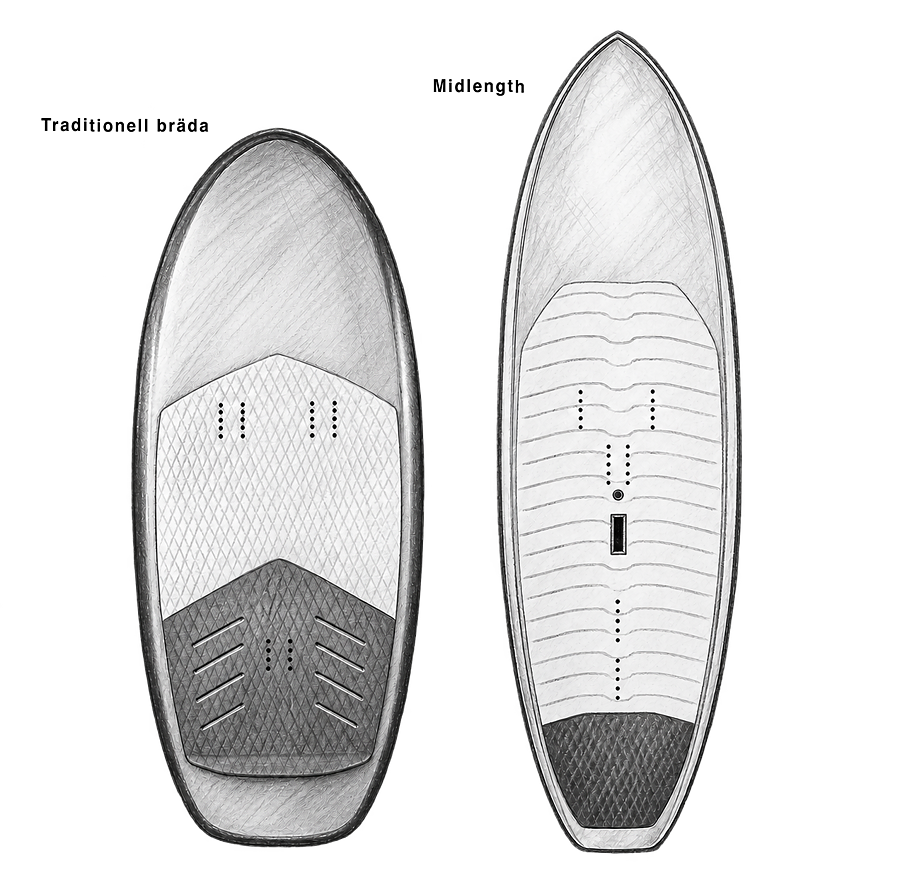
For a complete beginner in wingfoiling, we usually recommend a stable all-around board. If you have solid experience with, for example, windsurfing, SUP, or other board sports, a midlength board can be an interesting option.
Hardboard or inflatable board?
A hardboard is typically stiffer and offers better response and control. An inflatable board is easier to transport and store, but can be less efficient and responsive. If you’re able to transport and store a hardboard, that’s usually our first choice.
The Foil—How to Choose the Right One
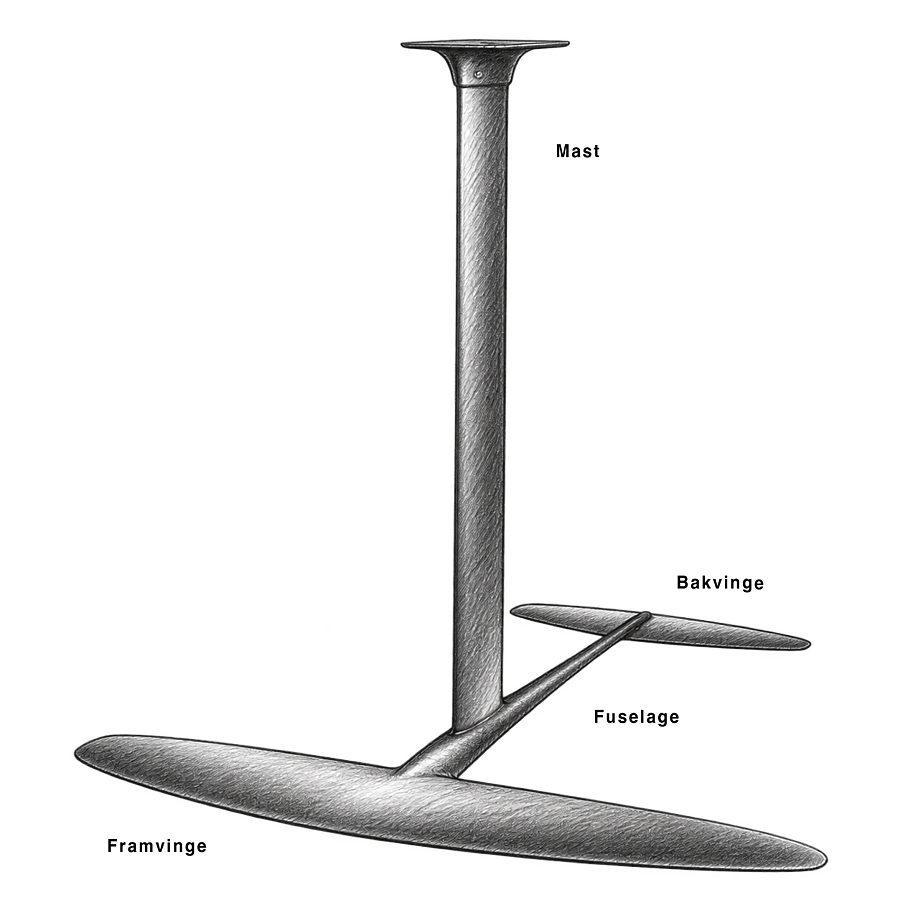
The foil is the part of the equipment that generates lift and allows you to fly above the water’s surface. A complete foil typically consists of:
Front wing
Rear wing
(stabilizer)
Fuselage
Mast
All of these parts affect how the foil behaves.
Front wing size
The front wing’s surface area is measured in square centimeters (cm²).
A larger front wing with a beginner-friendly profile typically provides good lift at lower speeds. A smaller front wing often requires higher speed but can offer less drag and a higher top speed.
It’s important to understand that size isn’t everything. Two front wings with the same surface area can have completely different characteristics depending on their shape, profile, and construction.
| Body Weight | Recommended front wing |
|---|---|
| 50–65 kg | 1,300–1,600 cm² |
| 65–75 kg | 1,500–1,800 cm² |
| 75–85 kg | 1,600–2,000 cm² |
| 85–100 kg | 1,800–2,200 cm² |
| Over 100 kg | 2,000–2,400 cm² |
Approximate ranges for beginner-friendly foils.
Part 8
Low aspect, mid aspect, and high aspect—what’s the difference?
When comparing foils, you’ll often come across the terms low aspect, mid aspect, and high aspect. These terms essentially describe the ratio between the wing’s width (span) and its surface area.
Low aspect
Compact and easy to control.A low-aspect foil has a relatively short span and a wide wing. It often features:
- Good lift at low speeds.
- A compact shape.
- Easy-to-maneuver characteristics.
- More drag at higher speeds.
Many older beginner foils had this type of shape.
Mid-aspect—Our top choice
The versatile foil.The mid-aspect foil is a very interesting option for both beginners and more experienced riders. It often combines:
- Good lift.
- Good stability.
- Efficient glide.
- Good turning characteristics.
- A wide range of uses.
This is often our top choice for beginners who want to be able to progress using the same foil.
High aspect
Efficiency and glide.High-aspect foils have a longer span and a narrower profile. They are often designed for:
- Efficient glide.
- Higher speeds.
- Good pumping ability.
- Longer distances.
However, they can be more technically demanding and less forgiving. There are also modern high-aspect foils that work for relatively inexperienced riders, but the choice requires more consideration of the specific model.
Don’t just look at the front wing’s surface area or aspect ratio. Profile, span, thickness, and construction are all very important. We’ll help you find a foil that suits your skill level and weight.
Part 9
What mast length should you choose?
The mast is the vertical section between the board and the foil. Its length affects how high above the water you can fly and how much leeway you have in waves and chop.
60–70 cm
A short mast can be good for your very first practice sessions. It provides a shorter drop height and may feel easier to control. The downside is that you have less margin before the foil breaks the water’s surface.
75–80 cmBeginners
A very good length for beginners. It offers a good balance of control and margin relative to the water’s surface. This is often the mast length we recommend for your first set of personal gear.
82–85 cm
A common length for all-around riding. Provides better margin in chop and waves and works well as you begin to develop your technique.
90 cm and longer
Often used by more experienced riders or in specialized disciplines. Provides greater margin in waves but also requires deeper water.
A mast around 75–80 cm is a good first choice. If you’ve already gotten started with foiling, 80–85 cm can also work great.
Part 10
Aluminum or carbon fiber mast?
Aluminum
Aluminum is a very good material for beginners. The advantages are:
- Lower price.
- Sturdy construction.
- Good rigidity on many models.
- Easy and affordable to replace when needed.
The main drawback is its weight.
Carbon fiber
Carbon fiber masts can be both lighter and very stiff. They’re often used in more advanced foil systems and provide good response and control.
The downside is the higher price.
A good aluminum mast will serve you well for a long time. When you’re just starting out, it’s better to spend your money on the right front wing and board rather than on the most expensive mast.
Part 11
Fuselage and Rear Wing—What Do They Do?
The fuselage is the part that connects the mast, front wing, and rear wing.
- A longer fuselageoften provides a smoother and more stable feel in the longitudinal direction.
- A shorter fuselageusually makes the foil more responsive and easier to turn quickly.
The rear wing helps stabilize the foil and affects how it responds to your weight shifts.
For a beginner, we recommend purchasing a complete foil system where the parts are designed to work together. It’s also wise to choose a system that allows you to later swap out the front wing and rear wing without having to buy an entirely new foil.
Part 12
Examples of Complete Beginner Sets
Here are three examples of what a well-balanced beginner’s setup might look like.
| Equipment | 60 kg | 80 kg | 100 kg |
|---|---|---|---|
| Wing | 4–4.5 m² | 5–5.5 m² | 6–6.5 m² |
| Board | 90–100 L | 110–120 L | 130–140 L |
| Front wing | 1,400–1,600 cm² | 1,700–1,900 cm² | 1,900–2,200 cm² |
| Mast | 75–80 cm | 75–80 cm | 75–80 cm |
| Foil type | Stable freeride | Stable freeride | Stable freeride |
These are examples for general all-around riding and are not exact product recommendations. Your height, experience, local wind conditions, and the specific characteristics of the equipment always influence your choice.
Part 13
What accessories do you need?
In addition to the wing, board, and foil, you’ll need a few essential accessories.
Helmet
Always wear a helmet designed for water sports.
Floatation or impact vest
Provides protection and, depending on the model, buoyancy. Keep in mind that an impact vest is not automatically an approved life jacket.
Wing leash
Prevents the wing from blowing away if you drop it.
Board leash
Prevents the board from drifting away. Choose a model and attachment method that suits the conditions.
Wetsuit
In Varberg, a good wetsuit is essential for much of the year.
Wetsuit shoes
Provide warmth and protection when entering and exiting the water.
Pump
Make sure the pump fits the wing’s valves and always follow the manufacturer’s recommended air pressure.
Foil bag and board case
Protects your gear during transport and storage.
The edges and tips of the foil can cause injuries. Wear protective gear, keep your distance from others, and choose a spot with sufficient water depth.
As a beginner, you should practice in steady, moderate winds and avoid strong, gusty, or offshore winds without organized safety support. Always check local rules and conditions before heading out.
Part 14
Common Mistakes When Buying Your First Gear
- Buying a board that’s too small—This is the most common mistake. Too little volume makes it hard to maintain balance and can significantly slow your progress.
- Choosing a foil that’s too advanced: A small or technically demanding foil can make it difficult to get airborne and stay flying.
- Buying the wrong wing size: A wing that’s too small can provide too little power. A wing that’s too large can be heavy and difficult to control.
- Comparing only the front wing’s surface area: Two foils with the same surface area can behave very differently.
- Failing to check compatibility: Foil parts from different manufacturers and model generations don’t always fit together.
- Buying equipment that’s too advanced to avoid having to upgradeIt’s often better to buy something that works well today and then upgrade your equipment gradually.
- Starting in the wrong wind conditions: Steady, moderate wind is significantly better for learning than strong, gusty wind.
Part 15
New or used wingfoil gear?
It’s definitely possible to start with used gear. A used board or foil can be a very affordable option, especially if you find a modern and well-maintained model. But always check the condition carefully.
Inspect the board
Look for cracks, soft spots, damage, and previous repairs. Pay special attention to damage that may have allowed water to seep in.
Check the foil
Inspect the mast, mountings, screws, front wing, and rear wing. Look for cracks, corrosion, and other damage.
Check the wing
Make sure it holds air and that the valves, seams, handles, and fabric are intact.
Keep up with the latest developments
Wing foil equipment has evolved rapidly in recent years. Modern foils can be significantly more efficient and easier to use than older models. That doesn’t mean older equipment is bad, but it’s important to compare the right products.
A cheap package isn’t always a good buy. Make sure the equipment is suited to your weight, experience, and the conditions where you’ll be riding.
Part 16
How do you upgrade your gear as you get better?
A major advantage of modern wingfoil gear is that you can often upgrade in stages.
- Learn the basics: Startwith a stable board, an easy-to-use all-around wing, and a forgiving foil. The goal is to learn how to launch, fly with control, and eventually make turns.
- Develop your riding: Onceyou feel confident, you can try a smaller or more efficient front wing. You can also add a second wing size to ride in a wider range of wind conditions.
- Find your own style: Onceyou’ve mastered the basics, you can start customizing your gear based on what you enjoy most—wave riding, freeride, freestyle, downwind, or light-wind riding.
So you don’t need to replace all your gear at once.
Part 17
Frequently Asked Questions About Wing Foil Gear
Is wingfoiling hard to learn?
Wingfoiling is easier to get started with than many people think, especially with the right gear. You don’t need any prior experience with water sports, but balance and an understanding of the wind help. With a stable board, an easy-to-handle foil, and a wing of the right size, you can quickly learn the basics. A course is the best way to get off to a good start.
Which wing should I buy as a beginner?
We recommend a stable and easy-to-use all-around wing with good power and control. The size depends on your weight and how windy it is where you’ll be riding. For most beginners, 4.5–6 m² is a good starting point. If you weigh around 80 kg, a 5–6 m² wing is often a good first choice. Be sure to choose a high-quality wing that you can grow with. Hard handles or a boom are highly recommended.
How big of a board do I need?
As a beginner, we recommend a board with about 20–40 liters more volume than your body weight in kilograms. So if you weigh 80 kg, 100–120 liters is a suitable size. A larger board provides better stability and makes it easier to get started. If you have previous experience with surfing, windsurfing, or foiling, you can often choose a slightly smaller board.
Which foil is best for beginners?
Choose a stable and easy-to-handle foil that lifts early and performs well at lower speeds. A front wing of about 1,500–2,000 cm² is a good starting point for many beginners. We recommend a mast around 75–85 cm. Avoid foils that are too small or too fast at first—stability and control are more important than top speed.
Do I need two wings?
To start with, one wing will take you a long way. Choose a size that suits the wind conditions you usually ride in. Once you’ve improved, you can add a smaller wing for stronger winds or a larger one for lighter winds. For example, many people choose to combine a 4 m² and a 6 m² wing so they can ride on more days.
Is carbon fiber better than aluminum?
Carbon fiber is generally lighter and stiffer, which provides better responsiveness and performance. Aluminum, on the other hand, is an affordable and durable alternative that works great even for beginners. We recommend that you prioritize a high-quality foil design from an established brand. That’s more important than whether the mast is made of carbon fiber.
Can I use the same foil as I get better?
Absolutely! If you choose a good foil system from the start, you can continue to improve for a long time with the same basic equipment. With established manufacturers, you can often swap out the front wing, rear wing, or mast as you get better. That way, you won’t have to buy a completely new foil every time you want to take your skills to the next level. That’s one of the reasons why we at Surfers recommend high-quality gear from the start.
Should I take a course before buying equipment?
Yes, we definitely recommend it! In our wingfoil courses in Varberg, you’ll learn the basics using modern equipment designed for fast and safe learning. You’ll also get the chance to figure out what size board, foil, and wing work best for you. This makes it much easier to make the right choice when you’re ready to buy your own gear. Learn more about our wingfoil courses in Varberg
Learn to wingfoil with Surfers in Varberg
If you’re completely new to the sport, we recommend starting with a wingfoil course here at Surfers.
- A four-hour course in small groups.
- We start with safety and wing handling on land.
- Then you’ll practice in the water with modern wingfoil gear—foil boards and shorter masts make those first steps easy and safe.
- All equipment is included.
By taking a course, you’ll also get a much better idea of which sizes and types of equipment are right for you.
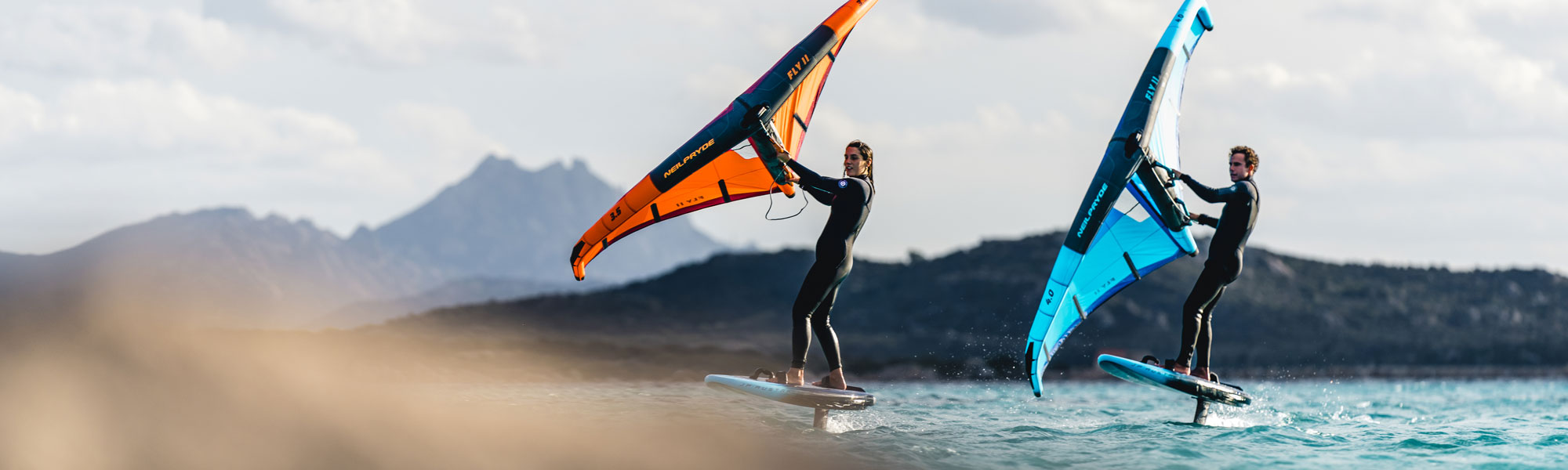
We’ll help you choose the right wing foil gear
At Surfers in Varberg, we’ve been involved in water sports since 1985. We have extensive experience with both equipment and instruction and are happy to help you find the right combination of wing, board, and foil.
Whether you’re completely new to the sport or come from a background in windsurfing, kitesurfing, SUP, or surfing, we can help you choose equipment that suits your skill level. When you contact us, please let us know:
- How much you weigh.
- How tall you are.
- If you have previous experience with water sports.
- Where you plan to wingfoil most often.
- What wind conditions you want to be able to ride in.
- What your budget is.
Then we can give you a personalized recommendation and help you put together a complete package.